Vera Weber
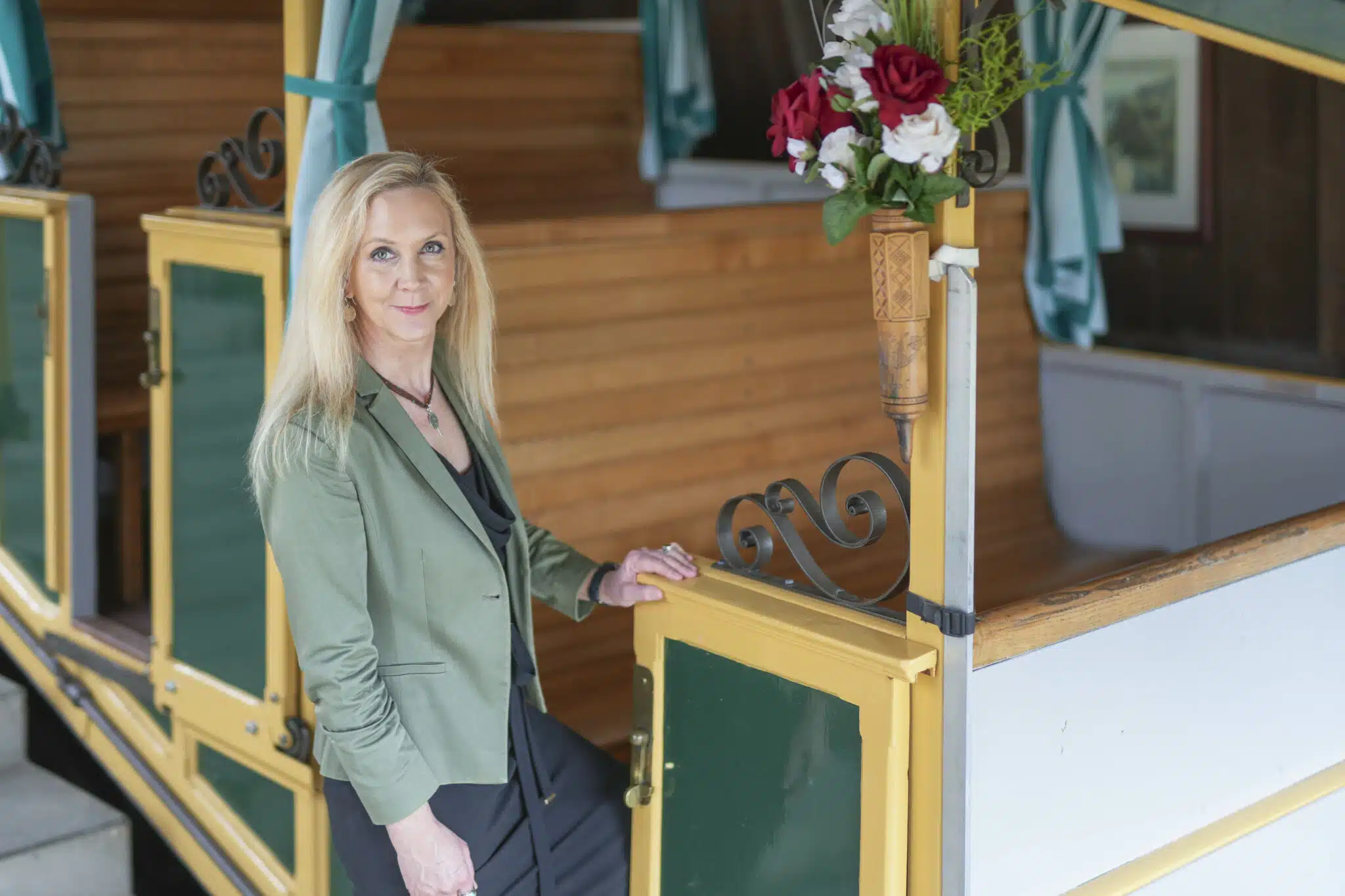
Since 1999 — that is, for more than a quarter of a century — Vera Weber has devoted herself to the Fondation Franz Weber (FFW). She has been its executive president since 2014. But in reality, she says, she has been part of the Foundation her whole life — being the same age as it, and having grown up amid the whirlwind of campaigns, press conferences, and the tireless commitment of her parents, Judith and Franz Weber.Vera Weber, in this jubilee year of the 50th anniversary, do you feel more anchored in the past or in the present?
Everyone has a story. So do I. But I live very consciously in the present — with memories of the past and thoughts firmly turned toward the future. The future needs roots. It’s a beautiful saying — and it’s true.
What thoughts accompanied you as you prepared this anniversary issue?
I’m moved to take stock of everything we’ve been able to accomplish over five decades. How many landscapes we’ve preserved, how much animal suffering we’ve prevented, how many cultural treasures we’ve saved, and how many people we’ve made aware, convinced, mobilized… And all of that with a small, independent organization. Perhaps the secret lies precisely there: small but formidable — and uncompromising on substance.
Which concrete successes fill you with pride, looking back?
An important milestone was the ban on the import of seal products in the EU in 2009. Later, in 2017, Switzerland followed suit, resulting in a drastic decline in seal hunting.
Another highlight was the initiative on second homes, whose campaign I led. It was the first national initiative won by the FFW. Even among its opponents at the time, it brought about a shift in mindset — many municipalities have now tightened their building regulations.
But the most moving success for me remains the defeat of the Ozeanium project in Basel. A huge saltwater aquarium in the middle of the city, far from the sea — it was outrageous. We ran a strong campaign, and the victory at the ballot box gave a voice to marine animals.
What was the decisive factor in this success against the Ozeanium?
The slogan: “Protect the oceans where they are.” It went straight to the point. Instead of wasting 100 million francs to create an artificial habitat, it’s better to invest those resources intelligently in genuine ocean protection — such as, for example, preserving fish and coral reefs. This idea made many Baslers stop and think. It was a moving victory.
Was this, for you, a step toward the end of zoos?
No. We are not calling for their abolition, but for their thorough reform. The idea of exhibiting wild animals comes from the 18th century — an era without photos, without films, without knowledge of animal welfare. Today, we know better. It’s time to act accordingly. Zoos are in pole position to do so: they have good infrastructure and competent staff, whose expertise would deserve to be put to better use than caring for exotic animals behind bars or glass. This concept is outdated.
What does a fundamental reform of zoos concretely involve?
Our “inSitu” project, aimed at protecting wildlife in its natural environment, seeks in particular to turn zoos into places of protection, not of exhibition. Injured or seized animals should be cared for there. Furthermore, we advocate ending the breeding of animals that will never be able to be reintroduced into the wild. As for animals such as elephants, which suffer particularly in captivity, they should be transferred to vast reserves. In France, an elephant sanctuary already exists; another is under construction in Portugal. And we have already arranged the transfer of five elephants from Argentine zoos to a protected reserve in Mato Grosso, Brazil.
Another longstanding battle of the FFW is the abolition of bullfighting. Why did you step up this commitment?
When I was in Canada for the seal hunt, an angry supporter threw at me: “You’d do better to deal with what’s happening at home — the bulls tortured for entertainment.” Of course, one cruelty does not justify another — but her remark struck me. So I revived the FFW campaign from the 1980s, and in 2008 organized a resounding trial before the International Tribunal for Animal Rights, founded by my father.
And you were successful?
Yes. It greatly strengthened the movement in Catalonia. The “Prou!” platform (“Enough” in Catalan) had launched a popular initiative that ultimately collected more than 180,000 signatures. The result: the Catalan parliament voted to abolish bullfighting on July 28, 2010 — the most beautiful day of my life! A few weeks later, I was able to recruit the leading figures of the “Prou!” platform. Now, we are fighting bullfighting on an international level — with success: many cities and countries in Latin America have banned it.
50 years of the Fondation Franz Weber — and yet some still wonder: is it still necessary?
More than ever. Today, nature is no longer destroyed only in the name of profit or through negligence, but increasingly under the guise of climate protection. That is utterly cynical. We are sacrificing our forests, our landscapes, our ecosystems — for supposedly “green” energy installations. Under the pretext of saving the climate, we are destroying what remains of the living world. It has become a dogma. Unquestionable. Untouchable. It tolerates neither nuance nor debate. Anything goes, as long as you slap the “climate protection” label on it.
The electricity law, which makes it easier to build solar and wind power plants, was accepted by the Swiss people. Shouldn’t one abide by it?
We reserve the right to intervene where it is particularly serious — as with the Gondosolar project in Valais or the solar park planned at Tamaro, in Ticino. We use our legal means in a targeted and effective way.
Abroad, huge solar and wind power plants are being built…
… and for that, entire forests are being razed and landscapes covered over. It’s a real massacre: the Reinhardswald, in Germany, that mythical forest of the Brothers Grimm, is being sacrificed for wind turbines. And elsewhere, in Portugal and Spain, hundreds of thousands of olive trees are being uprooted to install solar panels and wind turbines… It’s a crime, a total aberration, to sacrifice ancient and living ecosystems — in the name of a supposed climate protection that, in reality, destroys nature and weakens the ecosystems so vital to the survival of us all.
Does the FFW have more difficulty being heard abroad?
Yes and no. Switzerland is unique with its direct democracy, its laws protecting animals, nature, and the landscape, and the people’s ability to launch referendums and initiatives. Abroad, the FFW also achieves successes — by working with authorities at the regional and national levels.
It will be interesting to see how the framework agreement with the EU, on which the Swiss will soon vote, will impact the Fondation Franz Weber’s work.
I fear the worst!
Why?
This agreement… threatens our direct democracy. Today, we can directly improve the protection of animals and nature. With the framework agreement, many issues would be subject to European law. Initiatives could be launched, but no longer implemented. That would be an enormous setback.
… for other reasons as well?
Immigration would increase. That means more people, more pressure on nature and wildlife. Fewer natural habitats, more concrete, more meat consumption, more energy consumption.
You sound like an UDC politician…
I don’t engage in partisan politics. I speak as a defender of animals and nature. My cause is animals, nature, and the cultural landscape. I say it with no regard for left or right.
Critics say the Fondation Franz Weber spreads itself too thin: energy, animals, cultural heritage — several topics at once.
Our heart beats for animals, for nature — in all its diversity. Without nature, no life. Without landscape, no culture. Without cultural treasures, no identity. Everything is connected. And that is precisely why we act broadly — but never in a scattered way.
You speak of “we.” What does that say about your leadership style?
Precisely, I deliberately speak of “we,” because at the Fondation Franz Weber, a committed team works in Switzerland and around the world on our campaigns and projects. It would not be fair to speak only of myself. But what I can say with pride is that I had the vision for this team — and that I’m the one who built it.
You are often presented as “the daughter of Franz Weber.” How does that make you feel?
It’s the fate of all children of well-known figures, but it’s exhausting. This “daughter of” label certainly comes from a kind and good intention, but it obscures the fact that I am a person in my own right, with my own story, my own convictions, and achievements I’ve built through my own work.
You are the same age as the Foundation. Have you already thought about succession?
Of course. For years, we have been building a strong, intergenerational team — members ranging from twenty years old to over eighty. In addition, we are continually training new people. The Fondation Franz Weber will endure. Because our mission does not end with me — it will only be complete when animals and nature no longer need protection.