Can animals predict natural disasters?
Can animals predict natural disasters? Here’s what science says
Hours before the tsunami that devastated the coasts of the Indian Ocean in December 2004, unusual behaviour was observed among the region’s wildlife: elephants running to higher ground, flamingos abandoning their coastal breeding grounds, dogs refusing to go outside. When the wave arrived, many of these animals were already safe.
Coincidence? Instinct? A sixth sense? The question of whether animals can predict natural disasters has fascinated humanity since ancient times. And modern science is beginning to provide answers that are surprising, to say the least.
Documented cases: animals that anticipated a disaster
Historical records of unusual animal behaviour before disasters are numerous and come from very different cultures:
- Haicheng earthquake (China, 1975): the Chinese authorities evacuated the city partly on the basis of reports of unusual behaviour in domestic and wild animals. The magnitude 7.3 earthquake that struck hours later caused far fewer casualties than expected.
- Indian Ocean tsunami (2004): in Sri Lanka and Thailand, nature reserve rangers reported that elephants became agitated and moved inland hours before the waves arrived. Very few carcasses of wild animals were found in the devastated areas.
- L’Aquila earthquake (Italy, 2009): researchers from the Open University found that five days before the earthquake, 96 per cent of the male toads in a population had abandoned their breeding site, located 74 km from the epicentre. Three days before, not a single pair remained. It is one of the first studies to document animal behaviour before, during and after an earthquake.
- Turkey earthquake (2023): in the preceding hours, many social media users shared videos of unusual behaviour in dogs, cats and urban birds. The link with the subsequent earthquake reignited the scientific debate.
Which senses allow them to detect what we cannot?
Scientists have identified several mechanisms that could explain why some animals are able to anticipate certain natural disasters:
- Infrasound: earthquakes and tsunamis generate very low-frequency pressure waves (infrasound). In the case of a tsunami, these waves can reach the coast well before the wave itself. Many species – elephants, cetaceans, birds – can detect infrasound thanks to specialised sensory organs that humans do not have.
- Changes in the Earth’s magnetic field: some studies suggest that animals such as pigeons and certain species of fish are sensitive to changes in the geomagnetic field that may precede an earthquake. Magnetoreception – the ability to detect magnetic fields – has been documented in dozens of species.
- Changes in underground gases: seismic activity before an earthquake can release gases through fractures in the Earth’s crust and alter the chemistry of groundwater. Some animals with a highly developed sense of smell, such as dogs or pigs, might pick up some of these changes in the soil or water.
- Ground vibrations: the very faint vibrations that precede an earthquake can be picked up by animals with highly sensitive skin receptors, such as snakes and lizards, which spend a lot of time in direct contact with the ground.
Dogs, elephants, snakes: the best “natural sensors”
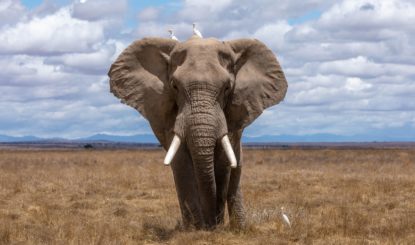
- Elephants: they are perhaps the animals with the best-documented ability to detect disasters. Their communication through infrasound and their extreme sensitivity to ground vibrations – which they perceive through the pads of their feet – make them extraordinarily sensitive early-warning systems.
- Dogs: a dog’s sense of smell, capable of detecting substances at concentrations of a few parts per trillion, could explain their ability to pick up chemical changes before earthquakes. Several studies have documented changes in the behaviour of pet dogs before earthquakes.
- Snakes: in China, 24-hour surveillance cameras have been installed at snake farms as a seismic early-warning system, based on the observation that snakes behave erratically days before earthquakes.
- Toads and amphibians: extremely sensitive to changes in groundwater chemistry, they are among the most studied animals in relation to earthquake prediction.
The Fondation Franz Weber works for the protection of elephants and other key species, not only for their intrinsic value, but because they are a fundamental part of the ecosystems we all share.
Why protecting animals also protects us
Research into animals’ ability to anticipate natural disasters highlights something that traditional cultures have always known and that modern societies have tended to forget: animals are not separate from our world. They are part of it. And their well-being and ours are deeply interconnected.
Protecting biodiversity is not only an ethical issue – although it fundamentally is one. It is also a matter of collective intelligence: animals have been adapting to this planet for millions of years and have developed abilities that we simply do not have. Ignoring them is, in every sense, a loss.
The Fondation Franz Weber works every day to make sure that loss does not happen. Through its animal protection and nature protection projects, the Foundation upholds the belief that animal life has a value far beyond anything we can measure.
The Fondation Franz Weber and the bond between animals and nature
Since it was founded, the Fondation Franz Weber has acted on the conviction that animals and nature deserve active protection, not just statements of intent. That conviction translates into concrete projects, emergency interventions and a constant presence wherever animals need someone to stand up for them.
If animals help us anticipate natural disasters, the least we can do is look after them. Support the work of the Fondation Franz Weber and help build a world where the bond between people and nature is respected and protected.